Announcing: Against Stupidity – the Webcomic

Heya readers,

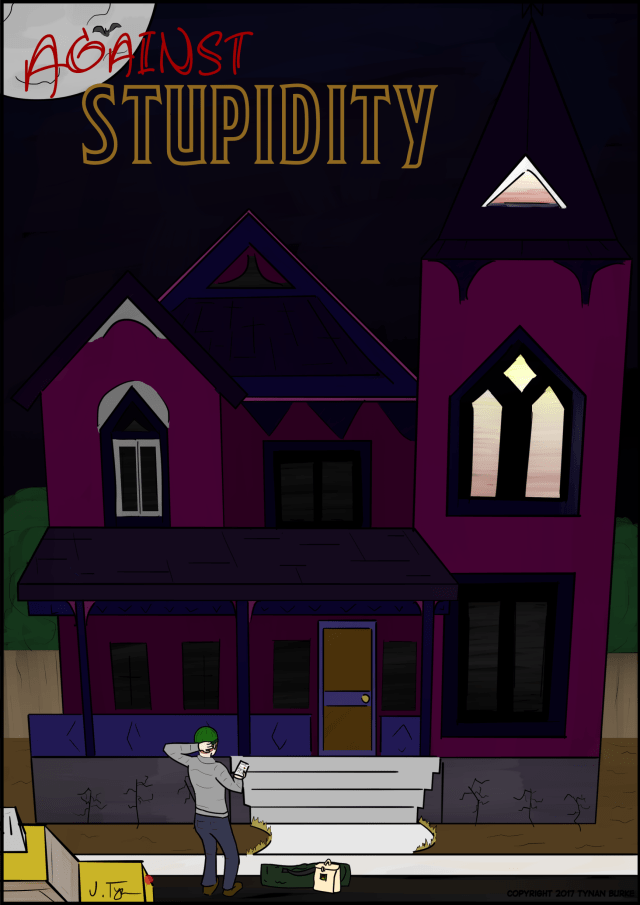
I’m pleased to announce the launch of my new public project, a webcomic named Against Stupidity. From the summary:

Meet Jesse Grunwald.

He just finished two years at community college in Santa Fe. In a fortuitous coincidence, earlier this year, he got offered a four-year scholarship at a Denver university and inherited his grandmother’s estate–a vintage victorian right by the lake in south Denver. Now it’s fall, and he’s moving in. He’s prepared to balance the quadruple demands of keeping up his GPA, holding down a job, making new friends, and keeping repairs up on the undoubtedly shitty car he’s about to buy. Unbeknownst to him, he’ll have to add two more demands–taking care of grandma’s pets, and holding up his magical karmic duties as the only grandchild of the powerful witch Clarita Grunwald.

I hope you’ll join and follow his adventures. Here’s the cover for Chapter 1, Over The River and Through The Woods:

Cover-color-2-bat.png

Tattooed Characters

As you may know I love procedurals and mysteries. Over the summer and fall I watched a lot of House, which is essentially a police procedural set in a hospital, and then when that ran out I wanted something lighthearted that I could stream before bedtime. For now I’ve settled on Rizzoli & Isles, which is sometimes dreadful but always soporific.

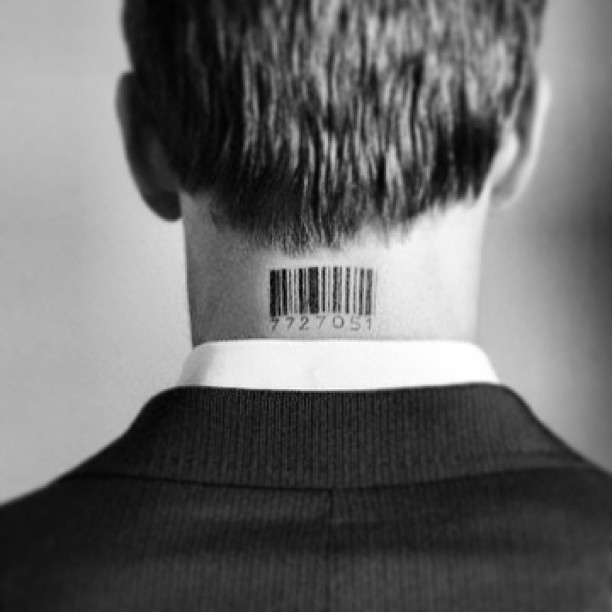
Anywho, the episode I watched last night involved a character who had a tattoo of a QR code. (It was actually a pretty good episode, too.) It got me thinking about tattoos on characters more generally. Marked bodies have relevance in all kinds of fiction, though the one I’m most familiar with is Germanic mythology and Norse sagas. In both, but especially in the sagas, very little physical detail about characters is given. When a detail is given, it’s one of the ways that you know that a character is not only important but different somehow. For instance, Odin only rises to his highest level of significance after he trades an eye for a look into the future.

This is an extreme example of conservation of detail, where you only mention things that are, in one way or another, relevant to the story. These can be scene-setting details and grounding details, or a way of getting to know a character better. In some genres, like historical fiction, a lengthy depiction of the setting is part of the form. In a Victorian Briefroman, an overly-formal description of characters and customs, even if not at all related to the plot, is expected. (I don’t care for the latter specifically because of this, but that’s merely a matter of personal taste.)

This is especially true in time- and space-limited formats like an hour-long mystery. You literally only have time for clues and red herrings and a bit of verisimilitudinous detail. So when this character was tattooed, it was important, especially because it wasn’t the sort of person you’d usually associate with a tattoo. A QR code is also something that contains explicit data, and probably isn’t just an asethetic throw-away. Unless it’s part of an extensive description of Maori tattoos or something else genre- or setting-relevant, then, a tattoo is a pretty important thing to put on a character.

I don’t currently have any characters with tattoos. I’m sure that I will soon, especially in the urban fantasy story that I’m working on (more on this to come!).

Finally, some random questions.

  • If you had a tattoo of a barcode, a normal barcode that represents a number, what would it be?
  • What about a QR code, which (usually) represents a URL?
  • I’ve long thought that a regular expression would make a fun tattoo. What pattern would you match?

Lampshades

I had an episode of House on in the background last night on Netflix while I was messing around on the Internet. After what would have been a commercial break, it shows House and Kal Penn’s character doing a walk-and-talk and Kal Penn summarizes what they’ve learned about the patient over the last ten minutes or so of story. House looks at him irritably (though does he do it in another manner ever?) and says, “what is this, some sort of recap?”

I find these things amusing. I also find them annoying if they’re overdone, but this just happened once, so it’s fine.

The end. 

Your Body Is Horrifying, pt. 1

Warning: rambling. -Ed.

It’s common, in trope-y writing, like horror or sci-fi, to intentionally make the reader feel a certain horror in or about their own body. This can also come up in authors who inhabit the ‘weird’ spectrum, like Borges or Murakami.

The thing about this is that it’s so easy. All I have to do is point out that you have a body.

We don’t like to think of ourselves as inhabiting a body. This comes in many flavors. Dualism is an extremely popular one. Your body is separate from your you. Your soul, your spirit, your whatever-you-want-to-call-it: your mind is not a part of your body, so your mind is not made of meat. Things made of meat are gross. We eat things made of meat. But your mind, which you’ve managed to separate from your body just by thinking about it (thinking is magical!), is still, you know, physically bound to your body. You can’t go anywhere that your meat doesn’t let you. You’re born meat, and you die meat.

Gross, right?

Now, there’s a second aspect to this. Bodies die. So we come up with elaborate mechanisms for which our bodies might die, but not us, not really. Dualism is a very strongly held belief in basically every school of thought, even atheism. So it’s not just that meat is gross–meat is mortal, too. Like I said, a lot of us eat it every day without really giving it a second thought. Any notion that your you-ness is all tied up in this meat nonsense is horrifying.

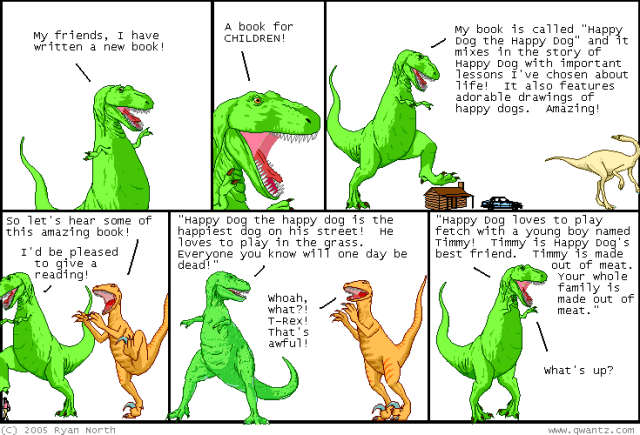
So how can I make sure you feel this? First, I can just tell you. You are mortal. You are made of meat. Like in this hypothetical children’s book from the inimitable Ryan North:

comic2-531
Or this gem, which Neal Stephenson sort of randomly plops down in the middle of a scene in Cryptonomicon:

The room contains a few dozen living human bodies, each one a big sack of guts and fluids so highly compressed that it will squirt for a few yards when pierced. Each one is built around an armature of 206 bones connected to each other by notoriously fault-prone joints that are given to obnoxious creaking, grinding, and popping noises when they are in other than pristine condition. This structure is draped with throbbing steak, inflated with clenching air sacks, and pierced by a Gordian sewer filled with burbling acid and compressed gas and asquirt with vile enzymes and solvents produced by many dark, gamy nuggets of genetically programmed meat strung along its length. Slugs of dissolving food are forced down this sloppy labyrinth by serialized convulsions, decaying into gas, liquid, and solid matter which must all be regularly vented to the outside world lest the owner go toxic and drop dead. Spherical, gel-packed cameras swivel in mucus greased ball joints. Infinite phalanxes of cilia beat back invading particles, encapsulate them in goo for later disposal. In each body a centrally located muscle flails away at an eternal, circulating torrent of pressurized gravy.

Isn’t that fun? In the first example, North just points out some meat and mortality; in the second, Stephenson makes it super gross. They’re not especially horrifying, I suppose, but they certainly make me nervous and a little squicked out, which is the point.

One thing that is horrifying, in its own special way, is a sci-fi short story (and a wonderful short film version) that does just this (linked above as well), in which the fact that we’re made out of meat is described from the point of view of somebody who is just now discovering that it’s even possible for something sentient to be made out of meat:

“They’re made out of meat.”

“Meat?”

“Meat. They’re made out of meat.”

“Meat?”

“There’s no doubt about it. We picked up several from different parts of the planet, took them aboard our recon vessels, and probed them all the way through. They’re completely meat.”

“That’s impossible. What about the radio signals? The messages to the stars?”

“They use the radio waves to talk, but the signals don’t come from them. The signals come from machines.”

“So who made the machines? That’s who we want to contact.”

They made the machines. That’s what I’m trying to tell you. Meat made the machines.”

“That’s ridiculous. How can meat make a machine? You’re asking me to believe in sentient meat.”

“I’m not asking you, I’m telling you. These creatures are the only sentient race in that sector and they’re made out of meat.”
[…]

This upsets the aliens enough that they decide to declare the sector uninhabited, erase all records of humanity, and move on. Later, they muse about how lonely it must be, thinking you’re alone in the universe, except they’re talking about an intelligent crystal or something or other.

So, in order to make you feel weird about your body (which is of course all you are and ever will be), I can:

  • Remind you that you’re mortal
  • Describe your body in excruciating detail
  • Talk about your body as though I’d never seen a body before

And we haven’t even gotten to the part where I have you imagine anything even happening to your body. All of these examples so far are just descriptive.

In Murakami’s The Wind-Up Bird Chronicle, one of the characters has a scar on her face and something wrong with her leg. He tends to mark his characters like this. In 1Q84 one of them has a weird ear. Body marking is also very important in the Germanic epics and sagas. This is the realm of injuries and minor mutilations. It sets people apart as different, or important, or both. That’s all another post though.

For now, man, how weird is it that you have a body?

Document formatting in fiction

(cross-posted)

Formatting is fun.

Time was, when you were ready to have a book published, you sent off your typewritten manuscript to the publisher and they determined what sort of physical form this would take. Typeface, page size, font size, paper stock, often cover art, hardcover vs. trade paperback, all that stuff.

That’s still true, to a large degree, but all the advances in technology for dead-tree printing have really let us go to town with creative formatting. This can take a variety of forms. I’m going to lead, however, with a historical example.

William Faulkner wanted The Sound and The Fury to be published with more than just black ink on white paper. (Well, he didn’t have anything to say about the paper.) But I do know that he wanted multiple ink colors to indicate the various speakers and time periods and intersections thereof. My recollection from undergrad is that he wanted four colors (or perhaps five if you include black); the Times article above suggests fourteen. At any rate, the publisher said ‘no’, because that would have been super expensive in 1929. (The ultra-deluxe 14-color modern edition linked above sold for $345 at printing, though I doubt this was strictly necessary and is almost certainly a case of conspicuous consumption for lit nerds.)

There’s an interesting discussion of how the new coloration may actually make the book too non-difficult to read. I wouldn’t know, since I read the broke undergrad Penguin Classics version, but it’s an interesting thought. I have the impression that The Sound and The Fury is sort of a rite of passage, and that this makes accessibility a bad thing, to a certain type of person. That’s a topic for another time I suppose.

So that was then, and this is now. Custom formatting is cheaper and easier, yay! I’ll admit that I first started noticing it when I was reading Cell by Stephen King, which would have been, gosh, ten years ago. One of the recurring images is the main character being crushed by a piece of construction equipment. The equipment’s brand is Link-Belt. “Here comes Link-Belt!” is I believe the refrain. But it’s in sort of a font like “Here comes LINK-BELT!” And as it gets closer and closer to crushing his leg (debilitating leg injuries are something of a motif for Mr. King), it gets bigger.

“Here comes LINK-BELT!”


“Here comes LINK-BELT!”


“Here comes LINK-BELT!”

(To this day, when I pass a construction site on the highway and see a LINK-BELT piece of machinery, I think of that.)

That’s fun. And technology is letting us do more stuff like that in more things ‘cuz cheap production, which is good. It even lets us do some completely bugf— crazy things like this.

house-of-leaves-sample

House of Leaves (Mark Z. Danielewski) is, uh, a thing that exists. (I did not take this picture.) It’s weird. Leaving aside the question of whether or not it pulls off what it’s trying to do, let nobody say that it doesn’t try to do it. And it just wouldn’t even exist if it we didn’t have the ability to do something like this for a few (seven) hundred pages relatively cheap. It costs about as much as any other roughly-letter-sized 700-page book. We aren’t talking about asking the publisher ‘can I use Helvetica instead of Times’? We aren’t talking about something like The Sound and The Fury here, where it’s maybe better/closer to the original intent if you have a few extra colors. Cheap formatting is an existential requirement for this book.

Yay cheap formatting! I’m generally in favor of books existing! Really going out on a limb there, I know!

Obviously this is even easier in digital formats. I’m going to go out on another limb and include web sites in that calculation. Philosophically they’re just books with javascript and a database, or perhaps more like the memex, but the relevant thing is, these were all conceived of as digital text, and in this sense ‘text’ means ‘a document’ and ‘a document’ means ‘a book’. (This is a lie, but a convenient one.)

Anywho, formatting is cool, and it lets you do things with a text that you couldn’t do before, and that’s good. Here’s something from the re-draft of (new working title) The World Beyond Eels:

formatting.png

Eel Pie Island Eel Pie Co.

First, a bit from draft 2:

James F.X. “Nuts” Adams sat on the pier waiting for the eel trawler to come in from the river. He drummed his fingers on the weather-worn wood. It hadn’t been varnished in a while. The splinter under his fingernail could attest to that. He’d just have to go ahead and add ‘re-varnish the pier’ to the chore list back at the eelhouse.

The eelhouse sat up on the hill behind him. EEL PIE ISLAND EEL PIE Co., read the old company sign. (Great granddad must have really strained himself, coming up with that name.) Like the pier, the sign was in dire need of re-varnishing. The whole building was. For that matter, so was everything else in London that had survived the Blitz. It wasn’t quite like that over on the Continent. Mom and dad liked to blame the weather for this, though what a bunch of clouds could have to do with it was beyond Nuts. He preferred to chalk it up to some sort of original sin unique to the English.

It smelled like woodsmoke and eels, inside the eelhouse. Frozen eel, dried eel, eel guts that could probably have been taken out back a little while ago. Empty fish tanks, about half of them shattered, adorned the walls. Eel pies baked in the wood-fired ovens. Nuts, Kate, and Blake sat by a hearth. They were wrapped in blankets and had their hands out to the glowing coals. Kate was still wringing out her hair and drinking brandy. Blake was coughing up river water and Nuts was shivering. Every so often, Kate would add a sentence or two to her story.

The front room of the eelhouse wasn’t a dining room, not quite. It had tables and chairs, yeah, but also a cash register and some supplies hidden poorly under sackcloth. The Co. wasn’t exactly a tourist attraction, but they got visitors from time to time, and it was nice to have a little place for them to sit. A small rack of pamphlets graced the wall by the door and a corkboard with assorted pictures hung from another.

Nuts and Cornelius and Kate sat at one of the tables. They had a little radio plugged in on the next table over. There was an eel pie, one of the big ones, steaming at the table with the radio, and Nuts and Cornelius had slices on plates in front of them. Kate said she wasn’t hungry.

Second, a friend of mine did some drawings!

Here they are, with and without some Instagram filters.

Liminality #4

Zach rode his bike into an alley in Little Seoul, where he found Cindy’s bike already locked up. The bike rack was overcrowded, so he locked his to hers, removed his helmet, clipped it onto the strap for his bag, and tried to make his hair dignified. Once in front of the alley, he spent ten seconds checking that he hadn’t been followed (FCC-EAD pre-mission field rule #7.a), confirmed that he had reception on no less than three devices (#7.b), and then proceeded into the doorway marked by a sun-scorched plastic sign that said “The Liquid Ambassador” and featured a drawing of something resembling a martini glass.

He rounded a corner and went down the stairs. Once belowground, he confirmed that he had no reception on any devices except for the emergency beacons (rule #7.b said nothing about reception once a mission started), and he entered the establishment proper. Passing by the bar, he ordered his usual, an Upper Illinois IPA, and joined Cindy, with her usual accompaniment of something-clear-on-the-rocks, at their usual booth in the corner.

The television sets on the walls played Ajeossi, a Korean revenge drama from the golden age of their cinema that Zach remembered seeing a few years back. The original title meant ‘Uncle’, and had been curiously translated into English as ‘The Man from Nowhere’. There was a particularly memorable standoff happening on the screens right now, by an empty swimming pool in a mansion-turned-slum. It would soon be followed by a bloodbath. It held Zach’s attention for a moment, and he mouthed a note, picked up by his earpiece, reminding him to watch it again some time.

Nearby, a half-dozen occupied karaoke booths leaked what amounted to a resounding wall of white and pink noise that obscured their conversation better than any auditory countermeasures they could have brought. The haze of cigarette and pot smoke emanating from the barstools formed a surprisingly effective barrier to lip-reading or even seeing very far, and the stateside variant of cash-stakes Pai-Gow taking place throughout the room would serve to distract any lesser law enforcement that might wander in.

These were, of course, rationalizations—a meeting room at the FCC-EAD would offer better protections. But, you see, The Liquid Ambassado had beer.

Zach sipped his. Too cold and flavorless. He took a glass from the stack on the table and poured it in, then tried again. Better.

“So, Zimmerman,” Zach said, “thoughts?”

“Well.” Cindy pulled her FCC-EAD tablet out of her bag and laid it open on the table. “There is one thing that does stand make this one stand out from a lot of the others.”

She tapped her finger on the text and highlighted a phrase. “Forty thousand requests per second? I think a few minutes of that would be enough to crash one of our servers.”

Zach sipped and thought. “Can’t they just close the port?”

Cindy, halfway through a sip of her own, shook her head. “I think Healthwire would have to reprogram all of the other hardware in their little experiment to go somewhere else, and this is a Defense grant, so who knows what kind of numbers they’re dealing with.”

“Hell, with that kind of money flying around, I’d be surprised if Healthwire knows what kind of numbers they’re dealing with.”

They shared a sad chuckle at that.

“This request rate has me a little worried, Zach. I think this one might actually be credible.”

Zach thought for a moment and realized he’d been holding the beer the whole time. He shook the moisture off his hands and rubbed them together to recover feeling. “I guss it explains the Deputy Director’s level of concern. Probably not the usual cover-your-ass job… Where the hell do we start?” He opened his tablet and scrolled through the file. “I mean, you can’t just waltz into a Comcast node. They might as well have armed guards.”

“They do,” Cindy said.

“Sure, but, like, they might as well have dogs and stuff too, I dunno. Any other avenues of inquiry we can try first, try to get a warrant? What about…” Zach trailed off.

For a while, they just read and drank, Cindy her something-on-the-rocks, Zach his IPA.

A waitress brought kim-chi pretzels. Zach tried a few and found them… flavorful. He tried to give them a chance every time he was at the Ambassador, always to no avail.

Cindy, for her part, almost always finished the bowl.

“Mm!” Zach said, and then failed to stealthily spit a half-chewed pretzel into a napkin.

Cindy looked up. Zach wiped his mouth and the table, stashed the balled-up napkin in the corner, and took a drink of beer. “We should look up what happened in town at 5:06 last night that might’ve triggered this anomaly. Power surge, fire, uh, rabbit attack…”

“Rabbit attack?”

“Quiet, I’m brainstorming. …accidental nanobot release, uh, escaped augmented horse?”

Cindy tapped her glass. “Disgruntled employees, I’ll check for firings or disciplinary violations… building demolitions, openings…”

“Remodelings…” Zach tried another pretzel. Nope.

Cindy swallowed some pretzels she’d been working on and washed them down with something-on-the-rocks. “I think we’ve got enough to go on here, Graves. Been a pleasure. Let’s regroup when we’ve got—”

“—at least three credible possibilities that all point to the same ISP node,” they said in unison, grinning stupidly, “pursuant with the 2025 DISA amendments, § 302.b.iv, regarding the warrant authority extended to the Department of External Anomalies, Federal Communications Commission Charter 15.255!” They clinked their glasses together and finished their traditional avant-mission beverages, then left at least four minutes apart as a deterrence against tails (pursuant FCC-EAD at-all-times field rule #2.d, waiveable in case of emergency without explicit permission of a supervisor).

* * *

Zach and Cindy entered one of the glass-walled conference rooms that lined the third story’s main corridor, affectionately known as the fishtanks. The transparent walls went smoky as soon as they entered, and mounted panels were populated with the relevant documents, which in this case was just the initial report, plus the standard map and timeline of the investigating agents’ locations and actions.

Zack stopped, surprised. He’d read about these upgrades, but he hadn’t been listed as active on an eyes-only, priority one anomaly for, what, a year? The fishtanks really gave you the royal treatment on these. He whistled appreciatively. “Snazzy,” he said. “Wonder where we got the money?”

Cindy had already sat down and started connecting her laptop to one of the wall panels.

She shrugged. “You know how it goes, gotta spend the money or it won’t be in next year’s budget.”

“Fair enough.” He sat down and tried to connect his own laptop. “Uh, how does this even work?”

Cindy looked up. “You should be authorized to bluetooth onto any of these screens.”

“Yeah, it’s not discovering anything.”

“It’s working for me.” Cindy indicated the reflection of desktop up on the wall. “Do we need to call IT?”

Zach shook his head. “It’s fine, we’ll survive. I’ll just switch one of these to whiteboard mode…” He walked towards an unused panel. “Which is, uh—“

“Button in the bottom middle brings up the menu, touchscreen from there,” Cindy said with a sigh.

“…Got it. Cool. So.” He wrote Healthwire on the screen with his finger, underlined it, and then wrote 5:06pm? below. “I can start with the incident reports—fire, police, animal control—“

Cindy laughed. “Seriously, Graves, it’s not going to be a rabbit attack.”

“A good investigator never rules anything out,” Zach said, an index finger raised.

“That is so not true. For instance, I can rule out ghosts right now.”

“OK, fine, we can rule out ghosts. But as Holmes said—“

“Do you have to treat every case like it’s your first, and your only experience is from watching crime procedurals?”

“Can’t argue with results, Zimmerman. My office has a window.”

“Technically.”

Zach sat back down and started pulling up the municipal search engines. “Hey, if you throw a rock at it, it’ll break just like any other.”

“Well, I guess I’ll just have to test that some time. Anyway. You search incident reports, I’ll look for construction activity and see if anybody interesting has some new bad reviews on LinkedIn.”

Liminality #3

EYES ONLY

FCC-EAD 109.60.1.002

ZACH GRAVES is: Authorized to Read and Edit

Filed 05-09-02039 09:41 AM

By HEALTHWIRE (#a83f025)

CONTENT FOLLOWS.

If it had been printed, there would have been a page break at that point.

CONTENT:

EXECUTIVE SUMMARY:

We believe our Research & Development server has been compromised. At 19:06 CST yesterday (05-08-02039), an unknown device began attempting to connect over a proprietary API approximately 40000 times per second. An internal audit has determined that this is the result of a third party.

This API is currently being used in the testing of sensitive personal medical devices on a grant from the Department of Defense, and as such it is of the utmost importance that we locate and stop the individual or individuals responsible for this likely attack.

DETAILS FOLLOW.

Another virtual page break.

DETAILS:

The device in question is being developed to measure adrenaline and cortisol levels in soldiers during combat situations, with the goal of lorem ipsum dolor sit amit in order to improve lorem ipsum dolor in potential future conflicts in the sit fasdfeamit Theater.

Any tampering by third parties is unacceptable and could pose a dire security risk. We’ve been unable to glean specific information on the origin(s) of the requests, but have been able to identify that they are coming through a Comcast connection located downstream from the node in Fallen Oak, IL. Or, at any rate, they appear to be.

TRACE DATA FOLLOWS.

At least they finally got rid of that This Page Intentionally Left Blank nonsense, Zach thought, as he scrolled past yet another page break. The next section contained information on the IP Addresses being used (many) and the nature of the requests (all identical handshake initiations, it would appear).

Zach was taking notes when Cindy called back, her face materializing in front of his eye. “Well, Zimmerman, it would appear that something is indeed on fire,” she said.

“A matter of urgent national security, no less,” he said with an arched eyebrow and a hint of over-seriousness.

“For the good of this glorious nation, we must track down these evildoers,” Cindy said in the same manner.

“Shall we begin at the usual spot?”

“I’ll meet you there in twenty.” Cindy’s picture winked out of existence again.

These cases rarely amounted to much of anything, and this one seemed like another instance of an overly paranoid cover-your-ass manager assuming malice when shoddy engineering was a much more likely possibility. But, well, that’s defense contractors for you. And a certain kind of sysadmin. The kind you find in enterprise companies. Not the good kind.

Zach picked his messenger bag up from the floor and put his External Anomalies Division tablet inside, along with a bottle of water, a brownie, and a can of coffee from the refrigerated drawer in his desk. He checked that his Division-stamped .38 was in proper working condition, with full ammunition and a full battery, and then put it in his shoulder strap holster.

Zach Graves had everything he needed to do some investigating. He took his blazer off the back of the chair and put it on, then headed out the door to meet Cindy, snatching his bicycle helmet & lock from the hooks on the wall as he exited.

Liminality #2

From the outside, the headquarters of the Fallen Oak, IL Branch Regional Headquarters of the Department of External Anomalies, Federal Communications Commission Charter 15.255, looked like it sounded, which is to say, linear, deliberate, and far too large than seemed necessary at first glance. As almost all of the many agents, researchers, librarians, secretaries, hackers, and interns who worked there would tell you, it looked like that from the inside as well.

Zach Graves, Probationary Investigatory Agent III.a, was no exception.

Each floor, at least on the floors Zach had clearance for (one through five, excepting four), was laid out in a rather intentional fractal scheme, with a large central corridor branching left, right, up, and down at regular intervals, each subsequent hallway smaller than the last. It reminded him of some sort of Platonic ideal of the inside of a bird’s bones.

When Zach had started a few years ago, his office had been off one of the hallways that barely fit two people going crossways; now, he had a room off one of the coveted tertiary hallways, only two nodes away from the central corridor on the second floor. It wasn’t a corner office, exactly—indeed, the building’s design shunned the very idea of corners—but Zach did have a window for the first time in his working life.

Granted, the window looked out directly onto a disused portion of the southern face of the courthouse next door, which had been bricked in to keep the homeless out, but still, one had to measure career progress somehow.

On this particular day, Zach was busy with a Division tournament of hearts when the phone rang. He tapped his earpiece. “Yes, sir?”

“Hey, Zach. Whatever you’re working on, I’m going to need you to stop soon.”

“Well,” Zach said, typing gotta go, pick up where we left off again?, “Sure, give me a few minutes? I just need to wrap up this report.”

The other three players voiced their frustrations, not that they hadn’t all done the same rapid-fire cancellation at some point in the past. Zach empathized. The tournament was only in its second bracket, and it had already been four months.

“Call me when you’re done, OK?”

“Will do, sir,” Zach said. “Appreciate the flexibility.”

Zach waved his hand and the hearts game vanished, replaced on the monitor with the other desktop he used for actual work. He located the report and pulled it up in the editor. “In conclusion, further study is required,” he typed, and then saved it.

He skimmed the report for typos, and it looked like the autocorrect had taken care of everything he missed. And with that, he submitted An Examination of Common Causes of Wearable Climate Hardware Malfunction: FCC-EAD 107.22.5.208. It would be reviewed and sent back with recommendations in 2-3 business days before finalization and publication, at which point Zach would be tasked with selecting a colleague to draft the abstract. Finally, at the end of the month, the piece would go out with the External Anomalies Division’s monthly report, and the glorious cycle of bureaucracy would begin again.

The thoughts ran through Zach’s head in the regimented language that every bureaucrat found themselves thinking in, sooner or later.

No biggie. Time to call the boss. He tapped his earpiece again. “Jeffrey Tsao,” he said, and the line started to ring.

“Zach. Thanks for getting back to me so soon.”

“No problem. What’s going on?”

“Seems we’ve got a priority-one anomaly report coming in from Healthwire. Deputy Director Freeman said it’s our number one priority, in fact. I told him I’d put my best agent on it. Called you anyway.”

Cute. “I’ll get right on it, sir. Should I give Zimmerman a ring? We usually work well together.”

There was a pause. “That would probably be best, yes. You two have done some good work lately.”

“Thank you, sir. Anything I need to know that won’t be in the file?”

“Figuring out what’s not in the file is your job, Graves.”

“Touché, sir. Well, I’ll let you know if I need anything.”

“Please do. And try to stay within the usual budget this time. I’ll talk to you later.”

Get stuck in New Atlantic City one time, Zach thought, and you never hear the end of it.

The connection closed. He tapped his earpiece twice. “Cindy Zimmerman. Video.” The plastic rectangle in front of his right eye came to life with a semi-transparent “Connecting…” flashing gently. After a moment, Cindy’s face appeared, behind her an office much like his own.

“What’s on fire this time, Graves?”

“I don’t know, but Freeman would like it dealt with quickly. At a good stopping point in whatever you’re doing?”

Cindy’s eyes refocused as she looked past the screen, through the image to whatever she was doing, and then refocused on Zach.

“God, yes. I’m doing quota work.”

“Great. Let’s both give this file a read and then re-connect?”

“Sounds good. Zimmerman out.”

Zach refocused his own eyes as the image faded out and the screen turned back into the minor irritant in front of his eye that it was most of the time. He turned to his workstation and opened his assigned case files with a practiced gesture, selected the blinking red one, and started reading it.

Liminality #1

Liminality

lim·i·nal

ˈlimənl/

adjective (technical)

  1. of or relating to a transitional or initial stage of a process.
  2. occupying a position at, or on both sides of, a boundary or threshold.


0.0


Tien wound his ATV between the short trees that dotted Superior Crater. It was dark out, and no lights shone from the ruined city ahead. Rather peaceful, really, save for the occasional small mammal that he would swerve to avoid (or at least try to). There wasn’t a human in sight, or so the trackers told him. He let himself relax. It was nice to be out of the office.

He hadn’t seen the crater first-hand before. It was pretty, just like people said, if a bit… brownish. But brown grass was better than no grass.

The vehicle chirped and he looked at the dash. Fuel heat nominal; no threats or surveillance detected; no messages… ah. He’d entered the demilitarized zone between Canada and the US. This was, of course, expected, but the lack of markings meant that he had to rely on the equipment. Tien snapped out of his daydream, stopped the vehicle, and exited. He opened one of the hatches in the rear and pulled out the checklist and a pen. He would fill most of it out on his sleevetop later–best to do the paper part of the paperwork while things were quiet, since it took longer.

With the graceless efficiency of a seasoned public servant at the Ministry of Corrections, he began filling out the tedious form. Most of the legwork had been done by the computer, but for accountability’s sake he still had to check off all the right boxes, and then sign, date, and scan it for later filing. Not like it would matter much for him, where he was going, but it was quite important for future such experiments, and a duty was a duty.

About halfway through he reached back into the hatch and pulled out a black plastic briefcase. Opening it, he set aside some paperwork and pulled out a parcel of clothing–some nondescript suit, the kind you’d see on an extra in old movies–then stripped out of his Ministry jumpsuit and into the vintage design.

Back to the clipboard. Check. Check, check… he removed a device from the hatch and unfolded it onto the ground. Check. He turned it on, check, check… it activated with a whirring sound, and his sleevetop blinked green under the suitcoat to indicate it was the right kind of sound. Check.

After putting his old clothes and all the packaging and other detritus he’d managed to produce into the hatch, he checked one last box on the form, then signed it three times, dated it, closed the hatch, and fed it into the dashboard scanner. He detached a small rod from the vehicle and put it in his breast pocket with a practiced move, then stepped onto the device he’d unfolded. Finally he plugged the device into a socket on the side of the ATV, double-checked his footing, and pushed the only button on it he hadn’t already pressed. The whirring sped up, he gripped the pair of handles that stuck up from the middle, and vanished. A moment later, when the checklist had finished scanning, an antenna rotated briefly; one more moment and the ATV began flashing and then exploded with a cold, quiet spark, leaving a vaguely ATV-shaped scar in the dormant grass.